Your System Still Works. But How Much Is It Costing Your Business to Keep It Running?
Your legacy system still works, but is it holding your business back? Learn when to maintain, modernize, or replace outdated software.
12 min readBISYS.TECH
Your System Still Works. But How Much Is It Costing Your Business to Keep It Running?
Some systems have been running inside a company for so long that they've practically become part of the business.
Nobody remembers exactly when they were introduced. Some employees learned to use them on their first day. Others know their quirks, their limitations, and even the steps needed to prevent something from going wrong.
These systems have survived changes in management, new branches, server upgrades, and several generations of employees.
And they're still there.
They process invoices, manage inventory, handle operations, and generate reports. Their interfaces may look outdated, but they get the job done.
So a reasonable question comes up:
If the system still works, why change it?
The answer isn't as simple as it seems.
Because the problem with an old system isn't always what it does. Sometimes it's everything the business can no longer do because it depends on it.
Old Doesn't Mean Bad
Technology has a certain obsession with what's new.
New programming languages, new platforms, new architectures, and tools that promise to solve problems we may not even have.
But a system doesn't become bad simply because it was developed fifteen years ago.
In fact, some older applications perform their jobs with a level of stability that many modern systems have yet to achieve.
They reflect business rules, have been refined over the years, and handle situations that rarely appear in the requirements of a new software project.
Sometimes, behind an outdated interface, there's an enormous amount of accumulated knowledge.
And that knowledge has value.
Replacing a system just because it looks old can be as misguided as keeping it simply because it still works.
The right question shouldn't be how old it is.
It should be whether it still meets the company's needs today and whether it can continue doing so in the years ahead.
When the System Starts Making Decisions for the Business
Imagine a company using an administrative system developed almost twenty years ago.
For a long time, it served its purpose perfectly.
But the business changed.
Now it has more branches, needs to sell online, connect operations with suppliers, and access information from different locations.
The company wants to introduce new processes, but every request gets a similar response:
The current system can't do that.
To access information from another branch, someone has to generate a file.
To connect an external platform, an additional solution must be developed.
To obtain a performance indicator, information must be exported to Excel and combined manually.
To change a business rule, the company has to find the developer who understands that part of the application.
Little by little, the business begins adapting its decisions to the limitations of its software.
And that's when something important happens.
The system stops being a tool that supports the business and becomes a condition that determines how far it can grow.
Not necessarily because it was poorly developed.
It was simply built for a company that no longer exists in quite the same form.
The Cost That Rarely Appears in Reports
When businesses calculate the cost of maintaining a system, they usually consider licenses, servers, support, and development hours.
Those expenses are easy to identify.
But there are other costs that are less visible.
The employee who spends two hours every week preparing a report that could be generated automatically.
The department that enters the same information twice because its systems aren't connected.
The branch that has to wait until the next day to access updated data.
The sales process that can't be implemented because it requires an integration the current platform doesn't support.
Or the time a company loses investigating why two reports show different numbers.
None of these problems seems particularly serious on its own.
The problem is that they keep happening.
Week after week. Month after month. Year after year.
Eventually, they become part of how the company operates, and everyone starts treating them as normal.
Many businesses don't know what their technology really costs because they only measure what they pay for it.
Not what they lose by using it.
The Developer Nobody Can Replace
There's a particularly delicate situation.
A company has a system that works well, but only one person truly understands how it's built.
Maybe that person developed it originally.
Perhaps they inherited the project from someone else.
Or they're simply the only one who understands how its modules connect, where the important business rules live, and which parts should never be modified.
As long as that person is available, everything seems under control.
But what happens if they leave the company?
What happens if an urgent issue needs fixing and nobody else understands the code?
Or if a server upgrade causes a problem that has never happened before?
This isn't about questioning the skills of the person who developed the system.
It's about recognizing that a business shouldn't depend on one individual to maintain an essential part of its operations.
Missing documentation, unsupported technologies, and years of accumulated changes can turn even a small modification into a risk.
This is often called technical debt.
And although the term sounds complicated, the idea is simple: decisions and solutions that worked at the time but now make the software harder to maintain or improve.
Not all technical debt is the result of poor development.
Sometimes it's simply what happens after years of growth without a modernization strategy.
Migration Isn't Just Copying a Database
When a company decides to replace its system, the process often seems relatively straightforward.
Build a new application.
Copy the information.
Train the users.
Turn off the old system.
In practice, it's rarely that simple.
Because enterprise software isn't just screens, tables, and records.
It also contains years of operational decisions.
Business rules that have changed over time.
Exceptions created to solve specific problems.
Calculations that must produce exactly the same results.
Processes nobody documented because everyone already knows them.
Even behaviors that look like mistakes but have become part of how employees work.
During a migration, it's essential to identify which rules are still needed, which should be corrected, and which no longer make sense.
Copying everything without questioning it can bring the same problems into a new technology.
But ignoring what already exists can leave the new system unable to handle situations the old one managed correctly.
Migration isn't about recreating the past with a more modern interface. It's about understanding the past so you can build something better.
The Mistake of Changing Everything at Once
Some modernization projects begin with a reasonable goal and end up becoming much larger than necessary.
The company wants to replace its administrative system.
Then it decides to change its processes.
It takes the opportunity to reorganize departments.
It adds features it has never used before.
It changes its reports.
And it expects everything to go live on the same day.
The result can be a project that's difficult to control, with too many unresolved decisions and significant operational risk.
It doesn't always have to happen that way.
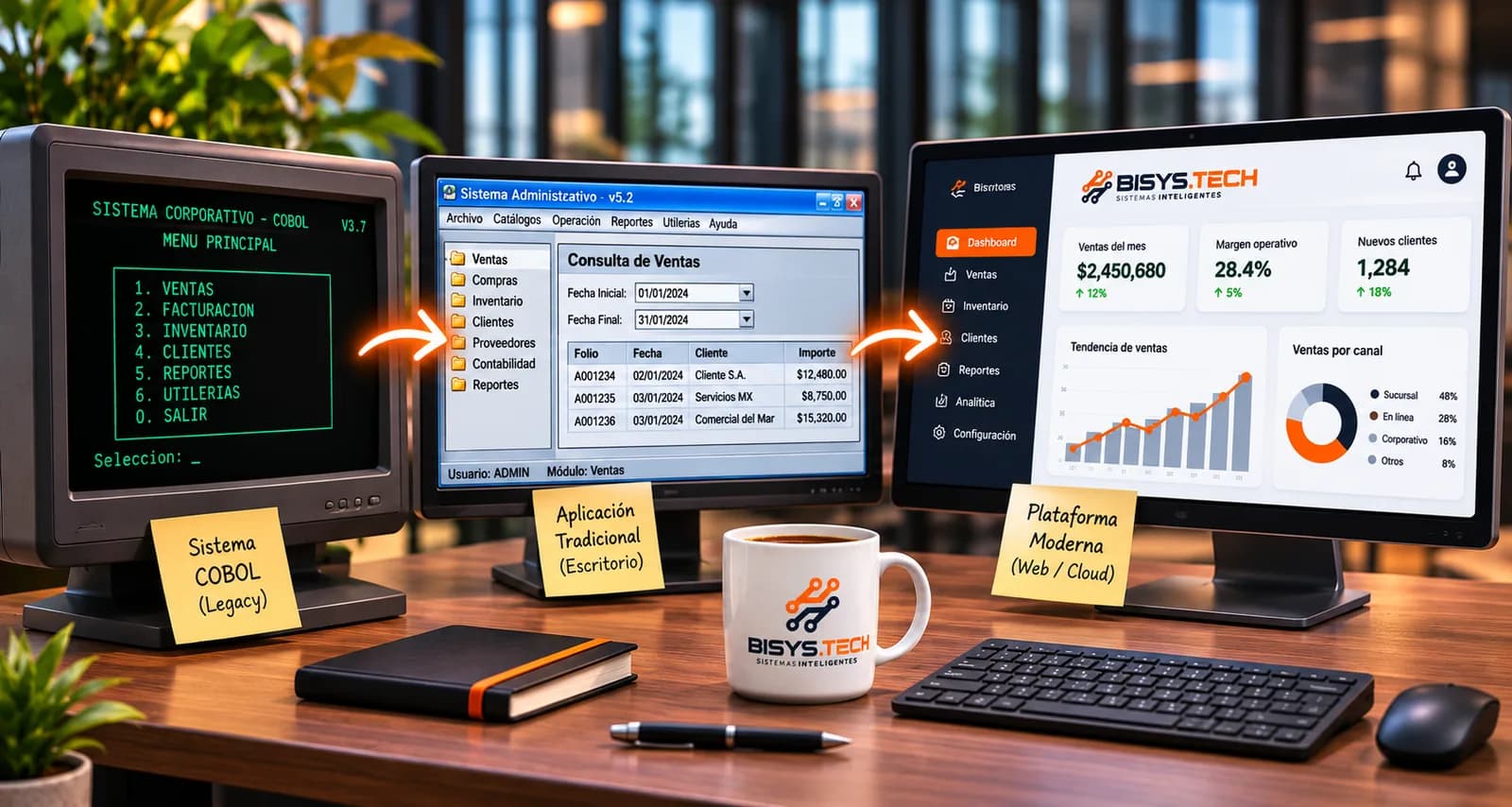
In many cases, a gradual strategy makes more sense.
For example, a company can temporarily keep its core system and develop an API that allows it to connect with other applications.
It can modernize its reporting first.
Then replace a module that no longer meets its needs.
Later, move certain processes to a web-based platform.
And continue until the old system is no longer necessary.
This approach has challenges too. For a while, two platforms may need to coexist, and it's essential to define which one owns each piece of data and how information stays consistent.
But when properly planned, it allows the business to move forward without putting its entire operation at risk in a single change.
Modernization doesn't have to happen overnight.
What matters is that every stage has a clear purpose.
Not Every System Needs to Be Replaced
Sometimes, the best recommendation is to keep the current system.
Maybe it works properly, has reliable support, costs a reasonable amount to maintain, and can still adapt to the company's needs.
In that situation, replacing it could create more problems than it solves.
There are also cases where improving infrastructure, updating components, documenting processes, or building integrations is enough.
And there are situations where continuing to invest in an old platform simply stops making sense.
The challenge is knowing the difference.
Before making a decision, it's worth reviewing the actual condition of the software.
Does it still receive support?
Can it be maintained securely?
Can changes be made without affecting other functions?
Can it connect with new tools?
Is the information accessible and reliable?
Does maintaining it depend on knowledge the company could lose?
Are the costs and risks of keeping it lower than those of modernizing it?
The answers help build a more objective decision.
Because this isn't about choosing between old technology and new technology.
It's about finding the solution that best supports the business today and in the future.
Modern Technology Doesn't Guarantee Success Either
Moving a desktop application to a web platform doesn't automatically solve all its problems.
Neither does using cloud services, microservices, or the latest programming language.
A modern application can still be poorly designed.
It can be slow, difficult to maintain, or unnecessarily complicated.
It can repeat the mistakes of the previous system and introduce new ones.
Modernization needs clear goals.
Improve security.
Make maintenance easier.
Enable new integrations.
Reduce manual tasks.
Make information more accessible.
Prepare the platform for growth.
And above all, protect business continuity.
Architecture, technology, and infrastructure should be selected based on those goals.
Not because they're trending.
At BISYS.TECH, we have a philosophy that sums up this approach:
Clarity Over Complexity.
Technology should solve problems, not create unnecessary complexity.
The Hardest Part Isn't Always the Code
There's something that often gets underestimated during migration: the people who use the system every day.
For a development team, changing a screen may seem like an obvious improvement.
For someone who has worked with that screen for ten years, it may mean changing a routine they've mastered.
A process that once took three steps may now require five.
A familiar function may have moved.
A report may display the same information in a different layout.
And even if everything works technically, users may feel the new system makes their jobs harder.
That's why modernization also means listening.
Understanding how work actually gets done.
Identifying which functions are essential.
Testing processes with the people who really use them.
And preparing the transition with enough time.
Training matters, but it doesn't replace good design.
A modern system should make people's jobs easier, not force them to adapt to technical decisions that never considered their daily reality.
The BISYS.TECH Perspective
At BISYS.TECH, we see system modernization as work that begins long before anyone writes code.
First, we need to understand what the current system does, why it works the way it does, and what the business actually needs.
Not everything that exists should be kept.
But not everything should be discarded either.
Some processes have proven their value over the years and deserve to remain.
Others can be simplified.
And certain limitations need to be removed so the business can continue growing.
That's why a good strategy may combine different solutions: connecting existing systems, developing new modules, modernizing applications, or building an entirely new platform when necessary.
The decision shouldn't begin with the technology we want to use.
It should begin with the problem we need to solve.
We also believe a migration plan should be easy to explain.
What will change.
Why it's worth changing.
What risks exist.
How information will be protected.
How results will be verified.
And what will happen if something doesn't work as expected.
Trust in a project isn't built by promising there will never be problems.
It's built by identifying risks, preparing for them, and making responsible decisions.
Before Turning Off the Old System
Imagine that after several months of work, a company is ready to launch its new platform.
The data has been migrated.
Users have been trained.
Integrations are working.
Core processes have been tested.
Everything appears ready.
But one question remains:
Are we sure we can turn off the old system?
It's not enough to confirm that the new application opens correctly or that records appear on the screen.
Balances, transactions, documents, business rules, and results must be validated.
Historical information that needs to be retained must remain accessible.
Critical processes must be tested under real operating conditions.
And there must be a contingency plan if something goes wrong.
In some projects, it makes sense to run both systems in parallel for a controlled period and compare their results.
In others, the transition should happen by module, branch, or business process.
There isn't one strategy that works for every company.
But there should always be a way to verify that the new platform is ready to take over operations.
Because a migration doesn't end when the new system is installed.
It ends when the business can trust it.
A Final Thought
A system that has worked for twenty years deserves some recognition.
It has probably supported the company's growth, solved important problems, and allowed thousands of operations to run successfully.
There's no reason to dismiss it because of its age.
But we shouldn't allow that past to determine every possibility for the future, either.
Businesses change.
Customers change.
Processes change.
And the technology supporting them needs to evolve too.
Sometimes an improvement will be enough.
Other times, a module will need to be replaced.
And in certain situations, building a new platform will be the right decision.
What matters is knowing when and why.
The real problem isn't having an old system. It's not knowing whether it's still helping your business move forward.
Modernization doesn't mean forgetting what worked.
It means using that knowledge to build what comes next.
BISYS.TECH — Clarity Over Complexity.