

The Illusion of Knowledge: When Building Is No Longer the Same as Understanding
We are living through one of the most extraordinary moments in the history of technology.
For the first time, almost anyone can build a website, a mobile application, a business platform, or even an entire SaaS product without writing a single line of code.
What only a few years ago required a full development team can now begin with a simple conversation with artificial intelligence.
That is fascinating.
It is also deeply unsettling.
For decades, building technology required a long and demanding learning process. Developers had to make mistakes, understand complex concepts, and spend years studying programming, databases, infrastructure, software architecture, security, system integration, and business processes.
The difficulty was not merely an obstacle.
It was part of the education.
Every technical problem forced professionals to develop a skill that may be more important today than ever before: the ability to question.
A developer did not only learn how to make something work.
A developer learned to ask:
Why does it work?
What will happen when it grows?
What am I sacrificing with this decision?
Is there a better alternative?
What happens when the business changes?
What will fail first?
Technical experience was never only about accumulated knowledge.
It was also about developing the instinct to challenge apparently correct answers.
Today, artificial intelligence is changing that process.
The Democratization of Technology
Artificial intelligence has democratized access to technology.
That is one of its greatest achievements.
People who may never have had the opportunity to study software development can now build prototypes, automate processes, create websites, and transform ideas into functional digital products.
This accessibility can unlock enormous creativity and innovation.
The problem begins when we confuse accessibility with mastery.
There is a significant difference between being able to build something and truly understanding what has been built.
Artificial intelligence has given us something that was once extremely expensive: speed.
We can now create in two days what previously required several months. We can generate thousands of lines of code in seconds. We can ask an AI model to propose architectures, databases, integrations, interfaces, and deployment strategies.
However, there is an uncomfortable question that is often ignored:
How do we know that what the AI created is actually what should have been created?
That may become one of the defining questions of this technological era.
We are teaching people how to ask artificial intelligence for answers.
We are not always teaching them how to challenge those answers.
The Illusion of Omnipotence
Artificial intelligence creates a powerful sensation.
It can make almost anyone feel capable of doing almost anything.
An entrepreneur can create a SaaS platform.
A designer can generate a web application.
A student can build an API.
A business owner can automate parts of an organization.
A person without formal technical training can generate something that appears to be a complete software product.
That is empowering.
But it can also create an illusion of knowledge.
The ability to produce a result is not the same as understanding the decisions behind that result.
Artificial intelligence can make someone appear to have years of technical experience within a few minutes.
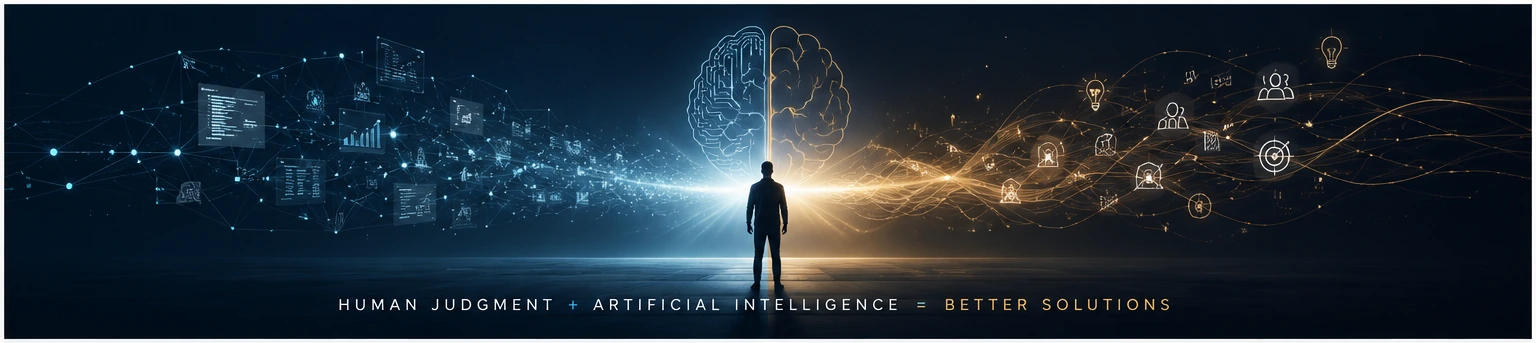
What it cannot transfer through a prompt is professional judgment.
It cannot instantly transfer:
- experience,
- intuition,
- critical thinking,
- architectural understanding,
- knowledge of technical consequences,
- the ability to recognize hidden risks.
When a system fails in production, the question is no longer:
How do we generate the code?
The question becomes:
Why was the system designed this way?
When data begins to disappear, integrations fail, or performance collapses, the issue is rarely solved by generating more code.
The real questions are deeper:
Which architectural decision led us here?
Which assumption was incorrect?
Which risk was ignored?
Which shortcut became technical debt?
At that moment, we discover that the most important knowledge was never inside the code.
It was inside the questions.
Artificial Intelligence Can Produce Convincing Mistakes
One of the greatest risks of artificial intelligence is not that it always produces obviously incorrect results.
The greater risk is that it can produce incorrect results that look convincing.
A generated solution may be well written, professionally structured, and technically plausible.
It may even work during a demonstration.
But software quality is not measured only by whether something appears to function today.
A responsible technical evaluation must consider:
- security,
- scalability,
- maintainability,
- data integrity,
- availability,
- auditability,
- performance,
- integration resilience,
- operational cost,
- future evolution.
A person without technical knowledge may not know which questions to ask.
They may not recognize that authentication was implemented incorrectly, that sensitive information is exposed, that a database model cannot scale, or that a dependency introduces a critical vulnerability.
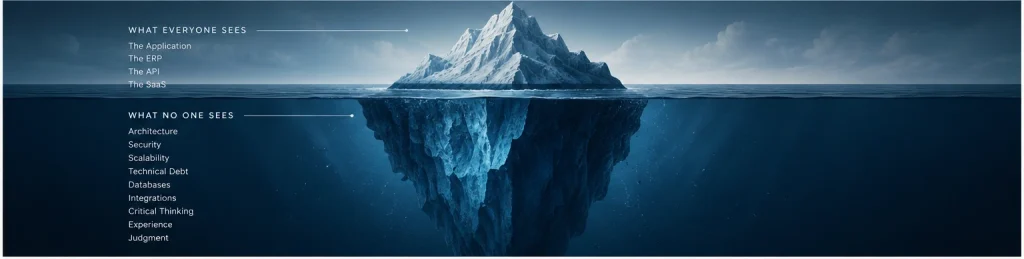
The system may appear complete because the visible interface works.
But the most important parts of professional software are often invisible.
Architecture is invisible.
Security is invisible.
Data integrity is invisible.
Resilience is invisible.
Technical debt is invisible.
Until something breaks.
Knowing How to Question the AI
The new essential skill is not simply knowing how to use artificial intelligence.
It is knowing when artificial intelligence is wrong.
That ability does not come from the AI itself.
It comes from prior knowledge.
A person with technical experience can examine an AI-generated solution and ask:
Why did you choose this architecture?
What alternatives were considered?
What are the trade-offs?
What happens under heavy load?
How are failures handled?
How is the data protected?
Is this dependency still maintained?
Does this solution follow the actual business rules?
What happens when the requirements change?
How will this be tested and monitored?
These questions are not decorative.
They determine whether a generated prototype becomes a reliable product or a future liability.
The value of technical knowledge is no longer limited to writing every line of code manually.
Its value increasingly lies in validating, correcting, and directing what artificial intelligence produces.
AI as a Substitute or as an Amplifier
Artificial intelligence is separating users into two very different groups.
The first group uses AI as a substitute for knowledge.
Their process looks like this:
Prompt → Generate → Copy → Deploy
When something fails, they often cannot identify:
- what failed,
- why it failed,
- which component is responsible,
- whether the proposed fix is safe,
- what consequences the change may create.
They remain dependent on artificial intelligence for every subsequent decision.
The second group uses AI as an amplifier of knowledge.
Their process looks like this:
Knowledge → Analysis → Prompt → Validation → Correction → Implementation
These professionals use artificial intelligence to move faster, but not to avoid thinking.
They know what to ask.
They know what to verify.
They know what to reject.
They know when the generated answer is technically elegant but operationally wrong.
They understand that artificial intelligence is not an authority.
It is a tool.
The same AI system can make an inexperienced person feel powerful while making an experienced professional genuinely more productive.
The difference is not access to the technology.
The difference is the ability to evaluate its output.
Is Artificial Intelligence Making Us Lazy?
Artificial intelligence can reduce repetitive work, accelerate research, generate documentation, and remove unnecessary friction.
That does not automatically make us lazy.
But it can make us intellectually passive.
The danger appears when we stop trying to understand.
When every error is immediately sent back to the AI.
When every architectural decision is delegated.
When every generated answer is accepted because it sounds confident.
When we lose the patience required to investigate a problem.
Tools have always changed how professionals work.
Calculators changed mathematics.
Search engines changed research.
Frameworks changed programming.
Cloud platforms changed infrastructure.
Artificial intelligence is another major transformation, but its reach is broader because it does not only execute instructions.
It appears to reason.
That appearance can tempt us to surrender our own judgment.
The problem is not using artificial intelligence to avoid unnecessary work.
The problem is using it to avoid necessary thought.
The Professional of the Future
For many years, developers were differentiated by the number of languages, frameworks, and platforms they understood.
Those skills will continue to matter.
But they may no longer be the primary differentiator.
The professional of the future will not necessarily be the person who writes code the fastest.
It will be the person who can:
- understand complex problems,
- translate business needs into technical decisions,
- evaluate alternatives,
- identify risks,
- question generated solutions,
- recognize incorrect assumptions,
- design systems that can evolve,
- take responsibility for the final result.
Programming will remain valuable.
But professional judgment will become even more valuable.
Anyone can ask an artificial intelligence system:
Build an ERP for my company.
The difficult questions are:
Should we build an ERP at all?
Which processes should be standardized?
Which rules create a competitive advantage?
Which data must remain historically traceable?
How should permissions be separated?
How will the platform support future business models?
Which parts should be custom and which should use existing services?
Artificial intelligence can generate answers to all of these questions.
But only someone with knowledge and experience can determine whether those answers make sense.
When the Difference Becomes Visible
Today, two people can present applications that appear almost identical.
One may have been created by an experienced software architect using AI as an accelerator.
The other may have been assembled by someone who accepted every generated recommendation.
During the first demonstration, both products may appear functional.
The difference becomes visible later.
It appears when the number of users grows.
When an integration changes.
When the database requires migration.
When new regulations affect the system.
When a security incident occurs.
When the business introduces a second company, location, currency, or operating model.
When the original creator must explain why the system was designed in a particular way.
One product may be scalable, maintainable, secure, observable, and prepared to evolve.
The other may become a collection of patches that nobody fully understands.
Artificial intelligence can reduce the time required to produce the first version.
It cannot eliminate the consequences of poor decisions.
Knowledge Is Accessible. Judgment Is Scarce.
For centuries, we repeated the idea that knowledge is power.
That statement remains true, but it is no longer complete.
Knowledge has never been as accessible as it is today.
A person can ask a question and receive an advanced explanation in seconds. They can access code, research, strategies, examples, and technical recommendations almost instantly.
The scarce resource is no longer access to information.
The scarce resource is judgment.
Judgment is the ability to decide:
Is this answer correct?
Is it correct for this specific context?
What is missing?
What risks are being ignored?
Is the fastest solution also the right solution?
Will this decision remain sustainable?
Judgment is built through study, experience, failure, observation, and responsibility.
It cannot be downloaded instantly.
It cannot be copied from a prompt.
It develops when someone understands enough to question a confident answer.
The BISYS.TECH Perspective
At BISYS.TECH, we believe strongly in artificial intelligence and its potential to transform how technology is created.
We use it to accelerate development, analyze alternatives, improve documentation, explore ideas, and reduce repetitive work.
But we do not confuse speed with quality.
We do not believe that more generated code automatically creates a better system.
We believe technology must be guided by:
- business understanding,
- clear architecture,
- reliable data,
- technical responsibility,
- critical thinking,
- long-term vision.
Our philosophy is simple:
Clarity Over Complexity.
This does not mean avoiding sophisticated technology.
It means refusing unnecessary complexity and understanding the consequences of every important decision.
Artificial intelligence allows more people to build.
That is positive.
But building something responsibly still requires knowledge.
Someone must understand the architecture.
Someone must question the assumptions.
Someone must validate the security.
Someone must protect the data.
Someone must anticipate how the product will evolve.
Someone must be capable of saying:
This answer looks convincing, but it is not correct.
That person remains essential.

Final Reflection
The important question is no longer whether artificial intelligence can build software.
It clearly can.
The important question is:
Who will be capable of evaluating what it builds?
Artificial intelligence can generate applications, websites, platforms, APIs, databases, and complete system architectures.
But it does not remove the need for professionals who understand what those systems mean, how they behave, and what can go wrong.
Anyone may now have the ability to create.
Not everyone has the knowledge required to question.
And in the age of artificial intelligence, the ability to question may become the most valuable technical skill of all.
Artificial intelligence can democratize the construction of software.
The judgment required to build it correctly remains deeply human.
At BISYS.TECH, we believe the future will not belong only to those who can build faster.
It will belong to those who know when to stop, examine the answer, and ask:
Is this really correct?
